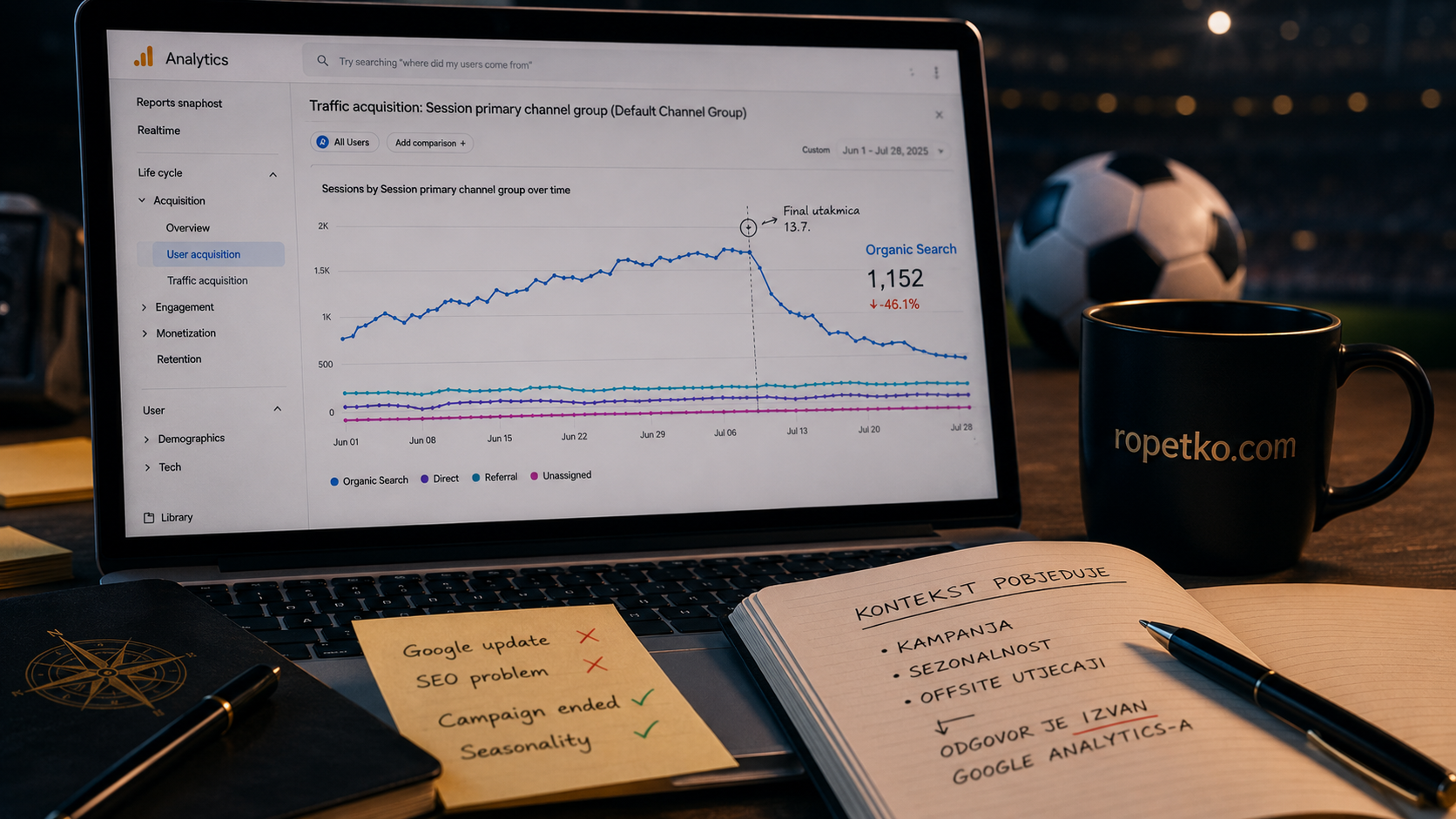
The FIFA World Cup has ended, and with it one of the biggest seasonal peaks in retail.
Many television manufacturers, retailers, telecom companies and FMCG brands plan activities months, and often years, in advance to take advantage of the increased consumer interest surrounding the tournament. During this period, marketing budgets grow, special offers are prepared, advertising intensifies, and users search for products and visit websites more frequently. When the tournament ends, some of that interest ends with it.
A few days or weeks later, someone in marketing will open Google Analytics and notice a drop in organic traffic. Their first thought will usually be:
“What happened? Who broke our SEO? Has Google changed its algorithm again?”
That is a perfectly reasonable question, but it is not always the right one.
A few months ago, a client approached me with a very similar question. After the Winter Olympics ended, they noticed a decline in organic traffic and asked me what had happened with Google, and whether artificial intelligence might have taken over some of their organic visits.
It was a perfectly reasonable hypothesis. AI tools increasingly answer users’ questions without requiring them to click through to a website, so it made sense to check whether something similar was happening to them.
I began analysing the available data. I looked at AI traffic, organic visits, landing pages, user engagement, conversions, revenue, website changes, search visibility and several other possible causes.
I also found a few genuine problems. Some pages had lost rankings after URL changes, some redirects had not been implemented particularly well, and there were several technical details that clearly needed to be fixed.
Still, something did not feel right. The conclusion was too obvious to explain the whole story.
Had those issues been the main cause of the decline in organic traffic, I would also have expected the quality of that traffic to fall. However, the engagement rate remained healthy, the conversion rate actually increased, and the decline in revenue was negligible and smaller than the drop in visits.
In other words, part of the problem was real, but it did not explain the whole story.
The client was also aware that the decline was not dramatic at that point. However, they knew that if the trend continued, panic could easily set in a few months later. That was precisely why they wanted to react early, and one of the reasons they contacted me.
After another conversation with the client, I asked a question nobody had asked before:
“Did you increase your marketing activity outside digital channels during the Winter Olympics?”
The answer was yes.
Television.
Radio.
Outdoor advertising.
Digital campaigns.
Everything had been intensified during the Olympic Games.
Suddenly, the answer became much clearer. Once the campaigns ended, especially the television campaigns, consumer interest naturally began returning to its usual level, and organic traffic declined with it.
SEO was not the main cause. SEO was simply the first suspect.
Situations like this are not unusual. They happen after major sporting events, large television campaigns, major PR activities, or any positive or negative event that temporarily increases interest in a brand. During periods of increased offline advertising, people talk about the product more, search for it more often, visit the website more frequently and return to it more often. Once that interest disappears, the numbers change again, and we often start searching Google Analytics for answers, either surprised or slightly panicked.
Google Analytics cannot know why the numbers changed.
Google Analytics does not know that the World Cup has ended.
When the World Cup ends, people think less about buying a new television.
When a major television campaign ends, fewer people search for your brand.
When a major PR story comes to an end, some of the interest it created disappears as well.
Google Analytics cannot know any of this.
Google Analytics will only show the consequences.
That is precisely why the explanation for changing numbers often lies outside digital analytics reports.
The next time you notice an unexpected rise or fall in organic traffic, you should certainly check your SEO, technical changes and content.
Before drawing a conclusion, however, ask yourself one more question:
What has been happening with our brand over the past few months?
Numbers rarely carry their own context. When we understand the story behind them, digital analytics does more than show us what happened on a website.
Digital analytics shows us how the real world is reflected in the data.


